Showing posts with label trigonometric functions. Show all posts

Friday, March 4, 2016

4.8 - Applications and Models (Story Problems)

Sections 4.8 explains how to use trigonometric functions to model and solve "real-life" problems

Some useful things to know in this section are angle of elevation and angle of depression.

  • Angle of Elevation  is the term that denotes the angle from the horizontal, upward to an object.


  • Angle of Depression is the term that denotes the angle from the horizontal, downward to an object.

Here is an example problem from the textbook of when to use angle of elevation
  • A safety regulation states that the maximum angle of elevation for rescue ladder is 72°. If a fire department's longest ladder is 110 feet, what is the maximum safe rescue height?
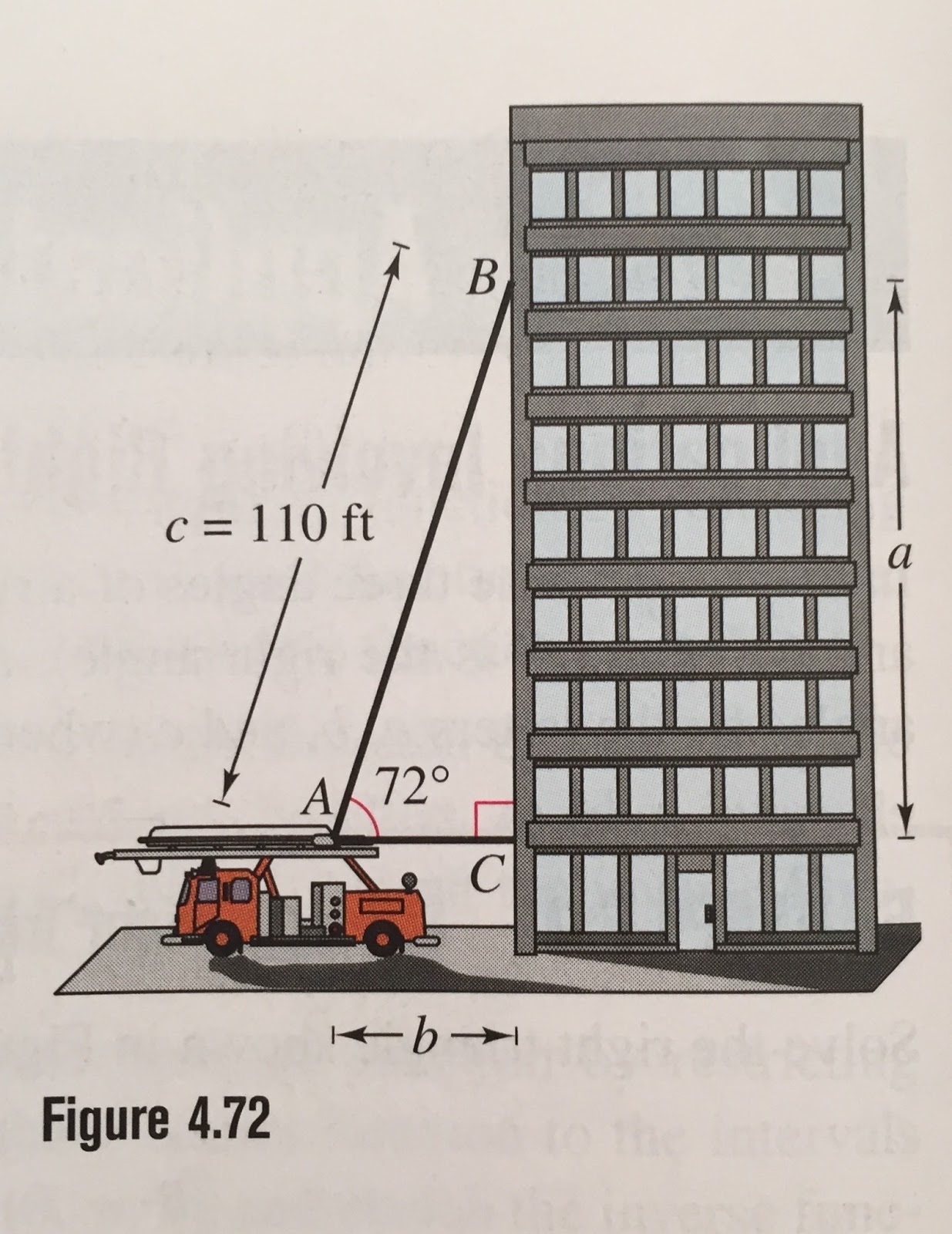
So from this picture and the problem we are solving for "a". From the equation sin A = a/c, we can conclude that a = c sinA. So a = 110 sin 72° ≈ 104.6. So, the maximum safe rescue height is about 104.6 feet above the height of the truck.


Trigonometry and Bearings

In surveying and navigation, directions are generally given in terms of bearings. A bearing measures the acute angle a path or line of sight makes with a fixed north-worth line.

For instance, the bearing of S 35° E means 35 degrees east of south


When dealing with bearings often time you'll be given a measurement like this: 39° 45' l
In this case the angle measurement would be (39 + 45/60)°

Wednesday, March 2, 2016

4.6 Graphs of Other Trigonometric Functions

Graph of Tangent Functions


  • Remember tangent is an odd function
    • tan(-x) = -tan(x)
  • This means that the graph will be symmetric with respect to the origin
  • tan x = sin x/cos x
  • tan x is undefined when cos x = 0
  • cos x = 0 when x=π/2 and x=-π/2
  • Thus y=tan x has vertical asymptotes at π/2 and -π/2
  • Since we know the period is π there are also asymptotes at x=π/2 + πn where n is an integer
  • Period of tangent and cotangent is π/b
  • In order to sketch the graph locate key points, identify intercepts and asymptotes, it is usually best to sketch more than one period.


  • Period = π
  • Domain =  all
  • Range = 
  • Vertical Asymptotes = 

Graph of Cotangent Functions

  • y= cot x = cos x / sin x 
  • Cotangent functions are similar to tangent functions however since sin x = 0 makes the cot x undefined the asymptotes are at x = nπ where n is an integer.
  • Notice the graphs of tangent are increasing while the graphs of cotangent are decreasing

 
  • Period = π
  • Domain = all 
  • Range =
  • Vertical Asymptotes = 

Graphs of Reciprocal Functions

  • 1/sin x = csc x
  • 1/cos x = sec x 
  • These graphs are found by using the reciprocal identities. These graphs also have asymptotes because for sec x for example it is undefined when cos x = 0. 
  • Also for given x, the y coordinates of sec x are the reciprocal of the y coordinates of cos x.
  • In order to graph the reciprocals csc x and sec x you must first graph the reciprocal functions which are sin x and cos x receptively, keep in mind the asymptotes.
  • You should get a u-shaped result, however it is not a parabola.

Cosecant Graph


  • Period = 2π
  • Domain = all
  • Range = 
  • Vertical Asymptotes =  
  • Symmetry= y-axis 

Secant Graph


  • Period = 2π
  • Domain = all 
  • Range = 
  • Vertical Asymptotes = 
  • Symmetry = origin
If you compare sine and cosine functions to their respective reciprocals you can notice in the graphs that the hills and valleys are interchangeable. For example the hill of the max point on a sine curve is the valley, or low point on a cosecant curve and vice versa.

Shifting Graphs
  • To shift the graphs of the parent functions
  • Use the same formula
    • y = a*tan(b(x-c))+d
  • Keep in mind the period for tangent and cotangent is π/b 
  • Also amplitude for tangent and cotangent is not necessarily important if the y axis isn't labeled
  • Also c is a phase shift and thus also effects asymptotes.
  • See section 4.5 for shifts of sin and cosine and definitions of each of the letters

All the graphs in one 


Tuesday, March 1, 2016

4.7 Inverse Trigonmetric Functions

Section 4.7 explains inverse trigonometric functions as well as compositions of functions.  It is convenient for trigonometric functions to have an inverse because it makes solving for angles of a right triangle much easier, but trig functions are not one-to-one.  By restricting the domain of the trig functions, each function has an inverse.

Inverse Sine


For the y = sin x graph above, the shaded area represents a section of the graph where sin x is one-to-one and the entire range is represented.  The domain [ -π/2, π/2] is where sin x has an inverse function y = arcsin x, or y = sin-1 x.
The above graph shows y = arcsin x.  Note that the domain and range have switched from the sin x to the arcsin x graphs.  Like all inverse functions, the input- x, and the output- y, switch.  

Inverse Cosine and Inverse Tangent
Inverse Cosine
Similar to y = sin x, y = cos x and y = tan x are not one-to-one unless the domain of these functions are restricted.
For the y = cos x graph the restricted domain is [ 0, π ].  When the x and y values are switched the y =  arccos x graph looks like:
Inverse Tangent
The domain of the y = tan x graph is (-π/2, π/2) to be one-to-one.  Note that unlike the restricted domain of y = sin x with brackets, the restricted domain of y = tan x has parenthesis because y = -π/2 and y = π/2 are vertical asymptotes.
Graph of y = tan x
Graph of y = arctan x

Compositions of Functions
When dealing with an inverse trig function composed of a trig function, or a trig function composed of an inverse trig function, the most important thing to remember is that an inverse trigonometric function equals an angle measurement.  
For example, to solve-
The first step is to recognize that
 
Next, cos x = adjacent/hypotenuse, so 3 is the measure of the adjacent side and 5 is the hypotenuse.  Using the Pythagorean Theorem or special right triangles, the opposite side is found to be 4.  Finally, sin x = opposite/hypotenuse, so 4/5 is the answer.
To sum it up,
Extra
For help with the range of inverse trigonometric functions (the restricted domain of trigonometric functions), here's a table-

Wordpress > Blogger