Showing posts with label sequence. Show all posts

Sunday, May 1, 2016

Summation Notation 9.1

9.1 Summation Notation 

This notation finds the sum of a finite sequence.


The Definition 


The index of summation can also be any letter you choose.

The lower limit of summation does not have to be one.


Example:

Check your answers with a calculator
If you want to check your answer you can do so using your graphing calculator. You would first press the math button and then press zero or scroll down till you see "summation  E(" the summation notation will appear on your calculator's screen. You will then plug in the numbers into the summation notation as you see them on your paper.

There is way to rewrite the summation notation when adding terms in series


The properties of sums

Thursday, April 28, 2016

9.2 Arithmetic Sequences

A sequence is arithmetic if the difference between consecutive terms is the same each time.
Arithmetic sequences have a common difference (d).
This means that:


An example of an arithmetic sequence would be
4,6,8,10,...

In this example, the common difference is 2.

The explicit formula for an arithmetic sequence is


The recursive formula for the previous example (4,6,8,10,...) would be


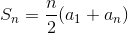
The sum of a finite arithmetic sequence is


Using the 4,6,8,10,... sequence with n=6, the sum would equal


= 54