Thursday, February 11, 2016

4.1 Radian and Degree Measure

Definitions

Trigonometry is the study of sides and angles of right triangles

Angles are two different rays with a common endpoint

The 2 rays in a angle are called the Sides

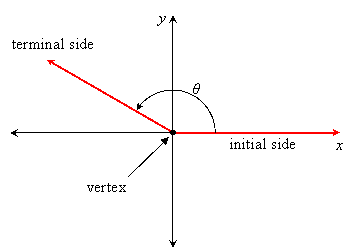
The common endpoint of an  angle is called the Vertex

Angle Measures are the measure of rotations or revolutions

Radians are the amount of rotation needed to make S=R

We count angles as clockwise or counterclockwise 

The side in which the angle lays on the x axis is the initial side

The side opposite of the initial side is the terminal side

Pi is the ratio of a circles circumference need to make S=R


Standerd Position

In standard position the vertex is centered on the origin

The initial side will always be on the positive x-axis

The angle implies both magnitude and direction meaning that it is a vector

It takes about 6.28 radi to get around circumference of a circle

The Arc is a portion of the circle


Angle Relationships

Congruent means angles that have the same angle measure

Supplementary means the measures of the angle adds up to 180 degrees

Complementary means the measure of the angle adds up to 90 degrees

Co-terminal means the initial and terminal sides are at the same position

Proportion means two ratios of each other


image curtesy of http://math.tutorvista.com/


Formulas 
 this formula is only good if theta is in radians

To find a co-terminal angle one must go from the initial side until it reaches the terminal side. If one adds 360 to that angle it will also be co-terminal to that angle.

Sunday, February 7, 2016

3.3 Properties of Logarithms

Change of Base Formula


The change of base formula may be used when you may need to change bases to evaluate a specific logarithm. If a, b, and x are positive real numbers such that a and b do not equal one, then log base a can be converted to a different base.


Properties of Logarithms


When two logarithms with a common base is multiplied by two numbers, it can be rewritten as the sum of the two logarithms. This same idea goes for division. When two logarithms with a common base are divided by two numbers, the logarithm can be rewritten as the difference of the two logarithms. The third property of logarithms involves the exponent being put at the front of the logarithm as expressed by the third equation above.

Example


Using the first property of logarithms it is possible to convert the natural log of 6 into the natural log of 2 plus the natural log of 3.

Example 2

All properties of logarithms work whether you are expanding the logarithm or condensing it.


x=3


Proof

Below is a proof of the division property for logarithms


b/c=b/c

Friday, February 5, 2016

3.4 Solving Exponential and Logarithmic Equations

Introduction
There are two basic strategies you can use to solve these equations.

One-to-One Properties

 if and only if x=y
 if and only if x=y

Inverse properties


Examples of Exponential Equations:

Can be we written as:

By the one-to-one property, x=5


x=ln 7 by the Inverse property

Solving an Exponential Equation in Quadratic Form

   or   
          
          
                     x  =  0

Solving Logarithmic Equations

ln x = 2
Exponentiate each side

Final Answer Without a Calculator

Solving a Logarithmic Equation

Isolate the log (divide both sides by 2)
Exponentiate both side (by base 5)
Use the inverse property


Change-of-Base Formula


Tuesday, February 2, 2016

3.2 Logarithmic Functions and Their Graphs

Understanding Logarithmic Functions


Definition of a logarithmic function: the inverse of an exponential function where a is the base


where the anti exponential function is equal to the logarithmic function

Note: Exponential function have x-inputs, while the logarithmic functions have x-outputs

Evaluating Logarithmic Functions:


Example #1: 

Write the logarithmic equation in exponential form 


Solution: 2 is the base of the equation, or a. Therefore according to the definition of a logarithmic function, the exponential form is:


where y=8, x=3, and a=2

Example #2:

Solve the equation for x


Solution: put the logarithmic equation in exponential form 


then simplify the equation so that you have a common base


in order to solve for x, set the exponents equal to one another, such as:


and solve for x

Final Answer: 

Example #3

Solve the equation for x


Solution: put the equation in exponential form

Final Answer: Impossible, because there is not an exponent that makes 3 equal -81

Calculator Tips

There are two functions that are used so commonly, they have made functions on the calculator making solving the equations faster and more efficient

Common log- 


Natural log-

Graph of a log function

Remember that a log function is the inverse of an exponential function, so it's the graph of a logarithmic equation is a reflection of the exponential equation over the line y=x


the red line graph represents the log function, as you can see it is a reflection over the line y=x

Exponential Function Properties:

D: 
R:
x-intercept: none 
y-intercept: (0,1)
Vertical Asymptote: none
Horizontal Asymptote: y=0

Logarithmic Function Properties:

D:
R:
x-intercept: (1,0)
y-intercept: none
Vertical Asymptote: x=0
Horizontal Asymptote: none

*NOTE: the domain and range, as well as the intercepts and asymptotes, are inverses of the exponential function(they switch)

Shifting of a logarithmic graph

d=shift vertical(upwards and downwards)
c=shift horizontally(right and left)
a=vertical stretch/compression, if (-) it is reflected over the x-axis
b= when b is larger, it causes the incline to happen slower, rate of change