Monday, January 18, 2016

Section 2.4: Complex Numbers

Certain quadratic equations have no real solutions. This is why they created the imaginary unit i which is defined as  where . A set of complex numbers is created by adding real numbers to real multiples of the imaginary unit. When a complex number is written  it is in standard form. 

Addition and Subtraction of Complex Numbers: 
If  and   are two complex numbers in standard form then the definition of addition and subtraction is:

Sum:

Example: 

Difference: 

Example:

Multiplying and Dividing Complex Numbers:
In order to multiply complex numbers in standard form, it is important to use the distributive property or also known as the FOIL method.

Multiplication:

Example:
The equation below is not in standard form:
Because   we can use that to change the equation to standard form
Final answer in standard form:

In division, in order to not have i in the denominator of the equation we use the complex conjugate (conjugate of the denominator) to solve the equation by multiplying it to the numerator and denominator of the original equation.

Division:

Example: 
Multiplying by the complex conjugate:


Answer not in standard form yet

 Final answer in standard form:

Imaginary Number Helpful Facts:


The answers of the equations come in full circle after four. This helps if you need to solve a problem like: 
 Because the answers rotate every four, divide the number by 4
 The remainder will tell you the answer of the question.
Because  and the remainder of the equation is 3:


Thursday, January 14, 2016

2.1 Quadratic Functions

Polynomial Functions: can be written in the form


Polynomial functions are classified by degree of the leading term, as follows:

    Degree                Name
0                             Constant
1                             Linear
2                             Quadratic
3                             Cubic
4                             Quartic
5                             5th degree

Today, we are focusing on QUADRATIC FUNCTIONS.


Quadratic Function: Let a, b, and c be real numbers and a cannot equal zero. The function


is called a quadratic function. For such functions, the graph is a parabola. 

An especially convenient form of quadratics for graphing is called vertex form, expressed as:


where the vertex is represented as (h, k). If a > 0, then the parabola opens upward. If a < 0, then the parabola opens downward.

In order to change an equation from standard form to vertex form, it is sometimes necessary to complete the process known as "Completing the Square". The procedure is as follows:

1. Write original function, in standard form.
2. Divide all terms by the leading coefficient of the first term. 
3. Divide the value of b by 2, then square it.
4. Move the value c to the very right of the equation. 
5. Add/subtract the value from step 3 to the first two terms, the do the opposite to the value of c, all the way on the right.
6. Factor the perfect square and regroup terms.


Example:   
       

The vertex of the above function would be (-5, 25), and the parabola would open downward as a result of the negative value of a.


2.3 Real Zeros of Polynomial Functions

In the graph of , you can see the x intercept is -3
Therefore, f(-3)=0 so x=-3 is a zero of the function. Now we know that (x+3) is factor of the function. To find the other factor of the function, you must divide the function by (x+3). There are two ways of doing this.

1. Long Division

The process is similar to long dividing integers.

Example:
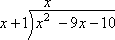
Set up the equation as you would in a regular long division problem
Divide the leading term of the dividend by the leading term of the divisor
Multiply the x by both terms in the divisor and place the product directly underneath the terms with the corresponding power
Just like regular long division, subtract the product from the terms above, leaving you with a single term
Bring down the next term, 10, and repeat the process of dividing the leading term by x, giving you -10

Multiply x and 1 by to give you the remaining product
Once again, subtract the product from above to finish the equation. Above the long division sign if your quotient,  x-10.

If the last step of subtraction does not equal zero, the equation has a remainder.
In this case, you take the number left over and put it over the divisor of the equation, giving you the remainder. 
Example:


with a remainder of -7

So the final answer is 


2. Synthetic Division

Example:

Put the coefficients at the top of a flipped division sign
Put 1, the known zero of the function, outside the box
Bring down the leading coefficient. Multiply the number by the zero and put the product below the next coefficient
Add the numbers in the column and multiply the sum by the zero. Place that product under the next coefficient
Again, add the numbers in the new column. If the last column equals 0, the solution has no remainder. In this case, there is a remainder of 12

Final Answer: